 Call Us : 08045814792Call Us : 08045814792
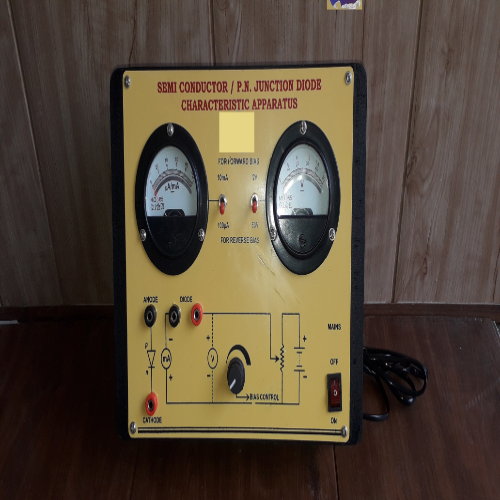
pn junction
1100.00 INR/Piece
Product Details:
- Voltage Forward voltage drop ~0.7V (Silicon), ~0.3V (Germanium)
- Automation Grade Manual operation
- Power Source External circuit required
- Feature Allows current in one direction (forward bias) and blocks in the opposite (reverse bias)
- Core Components P-type and N-type semiconductor materials
- Frequency DC to high frequency AC, depending on application
- Equipment Materials Semiconductor (typically Silicon or Germanium)
- Click to View more
X
pn junction Price And Quantity
- 1 Piece
- 1100.00 INR/Piece
pn junction Product Specifications
- Rectification, signal demodulation, switching, circuit protection
- Semiconductor (typically Silicon or Germanium)
- PN Junction Diode
- Allows current in one direction (forward bias) and blocks in the opposite (reverse bias)
- P-type and N-type semiconductor materials
- DC to high frequency AC, depending on application
- Approx. 1-2 grams (varies by packaging)
- Forward voltage drop ~0.7V (Silicon), ~0.3V (Germanium)
- Manual operation
- External circuit required
- Approx. 4mm x 2mm x 2mm (varies with package)
- Typically a few pF to tens of pF
- Yes (depends on manufacturer)
- ns to s range (depends on diode type)
- Anode (P-side), Cathode (N-side)
- Few nA (Silicon) to A (Germanium)
- -65C to +175C
- Typically from microamperes (A) to several amperes (A), depending on diode size
- DO-41, SMD, or custom package
- Power rectifiers, signal detectors, voltage regulators, logic gates, solar cells
pn junction Trade Information
- delhi
- Cash Advance (CA), Telegraphic Transfer (T/T), Cash in Advance (CID)
- 100 Piece Per Month
- 2 Days
- Sample costs shipping and taxes has to be paid by the buyer
- BOX
- Australia, North America, South America, Eastern Europe, Western Europe, Middle East, Africa, Central America, Asia
- All India
Product Description
PN junction in an electrical circuit allows current to flow more easily in one direction than another. Forward biasing means putting a voltage across a diode that allows current to flow easily, while reverse biasing means putting a voltage across a diode in the opposite direction.Efficient One-Way Current Flow
The PN junction diodes core design supports efficient current flow in the forward direction while reliably blocking reverse current. This unique feature makes it integral to rectification, switching, and protection circuits. Its stable performance across a variety of frequencies and low reverse leakage current ensure high reliability in both low- and high-frequency applications.
Versatile Applications & Compact Design
With compact dimensions and lightweight construction, the diode fits into numerous electronic devices. It serves roles in power rectifiers, logic gates, voltage regulators, and solar cells. Its robust build, broad storage temperature range, and RoHS compliance allow for flexible integration, meeting diverse circuit needs across industries.
FAQs of pn junction:
Q: How does a PN junction diode work in an electrical circuit?
A: A PN junction diode conducts electricity when forward-biased (anode positive relative to cathode), allowing current to flow. When reversed, it blocks the current, acting as a one-way valve for electrical signals. This fundamental behavior makes it useful for rectification and circuit protection.Q: What is the typical forward current range for a PN junction diode?
A: The forward current (IF) for a PN junction diode typically ranges from microamperes (A) in small signal diodes up to several amperes (A) in power rectifiers, depending on the diodes size and package type.Q: When should I use a silicon versus a germanium PN junction diode?
A: Silicon diodes are preferred for general rectification and power applications due to their higher forward voltage drop (~0.7V) and low reverse leakage. Germanium diodes, with a lower forward voltage drop (~0.3V), are chosen when low voltage operation or high sensitivity is required, such as in RF detectors.Q: Where are PN junction diodes commonly applied?
A: PN junction diodes are widely used in power rectifiers, signal detectors, voltage regulators, switching circuits, solar cells, and logic gates. Their ability to control current directionality is essential in both consumer and industrial electronic devices.Q: What factors should I consider when selecting a PN junction diode package?
A: Key considerations include the required current handling, size constraints, and mounting method. DO-41 and SMD packages are standard options, with custom packages available for specialized designs and higher power needs.Q: How does reverse leakage current affect diode performance?
A: Reverse leakage current is the small amount of current that flows when the diode is reverse-biased. Lower leakage (few nA in silicon, up to A in germanium) is preferable, as higher leakage can reduce efficiency or affect sensitive circuit operations.Q: What are the main benefits of using a PN junction diode in electronic designs?
A: The PN junction diodes ability to allow unidirectional current flow, fast switching, compact form factor, and compatibility with a wide temperature range provide reliability and versatility in numerous electronic applications.Tell us about your requirement

Price:
Quantity
Select Unit
- 50
- 100
- 200
- 250
- 500
- 1000+
Additional detail
Mobile number
Email


Address
MAYALAB INSTRUMENT
GST : 06EKTPK9532G1ZM
GST : 06EKTPK9532G1ZM
- House No - 108, Milap Nagar, Vill Nanhera Post Office, Kuldeep Nagar,Ambala Cantt - 133004, Haryana, India
- Phone :08045814792
- Send Inquiry
 Send Inquiry
 Send Inquiry
 Send SMS
 Call Me Free
 |
MAYALAB INSTRUMENT
All Rights Reserved.(Terms of Use) Developed and Managed by Infocom Network Private Limited. |
